


ECU Control Unit Encapsulation and Sealing
Precision potting, encapsulation and sealing solutions for automotive ECU control units — engineered for AEC-Q100 reliability, -40°C to +125°C thermal cycling and automotive-grade production throughput.
Automotive-Grade ECU Encapsulation and Sealing Solutions
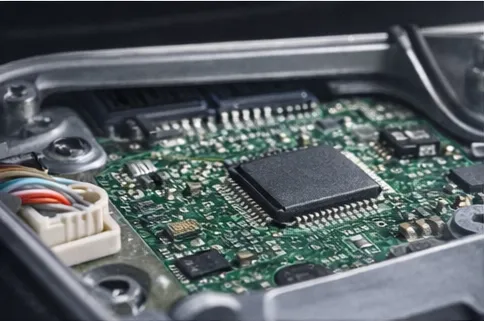
Automotive ECU assemblies — engine management units, transmission controllers, ADAS domain controllers and EV battery management systems — must operate reliably across -40°C to +125°C, survive 1,000+ hours of salt spray, resist engine bay fluids including oil, coolant and brake fluid, and pass 50G mechanical shock tests. The encapsulant or sealant applied to each ECU is the primary barrier between the electronics and this environment, and it must perform flawlessly across the full 15-year vehicle service life.
Two-component polyurethane (PU) and epoxy potting compounds are the dominant materials for ECU encapsulation. They fill the ECU housing completely, embedding the PCB and busbars in a rigid or semi-flexible matrix that distributes thermal and mechanical stress across the entire assembly. The key challenge is maintaining a precise A:B mixing ratio throughout the production run — even a 5% deviation from the target ratio can prevent full cure, leaving an under-cured region that absorbs moisture and causes electrical failure in the field. SANCO potting machines use real-time ratio monitoring to eliminate this risk entirely.
SANCO inline potting machines and offline potting machines are engineered for automotive ECU production — with heated dual-component feed systems, static and dynamic mixing options, and fill-level control to ±0.5 mm for consistent encapsulation quality across every unit.
Why Automotive ECU Encapsulation Is Process-Critical
Automotive ECU encapsulation must meet AEC-Q100 Grade 1 reliability across the harshest environmental conditions encountered in modern vehicles.
AEC-Q100 Grade 1 Thermal Cycling
Automotive Grade 1 requires reliable operation from -40°C to +125°C — a 165°C total excursion. Encapsulant CTE must be matched to the PCB substrate to prevent delamination or solder joint failure after 1,000+ thermal cycles.
Two-Component Ratio Precision
PU and epoxy encapsulants require A:B ratios from 1:1 to 10:1. A 5% ratio deviation can prevent full cure, leaving a tacky under-cured zone that absorbs moisture and causes electrical leakage. In-line ratio monitoring is essential.
Void-Free Fill in Complex PCB Topography
Tall components — capacitors, transformers, busbars — create shadow zones where encapsulant flow is restricted. Controlled fill angle, vibration degassing and optimised flow rate are required to achieve void-free fill.
Connector Interface Sealing
The ECU connector interface must remain sealed against ingress while maintaining pin electrical isolation. Precise fill-level control terminates the encapsulant below the connector sealing plane.
Automotive Fluid Resistance
ECU encapsulants in engine bay applications must resist brake fluid, coolant, engine oil and fuel vapour without swelling. Qualification to ISO 6722 and LV214 chemical resistance standards is required.
IATF 16949 Production Traceability
Automotive ECU lines target 500–2,000 units per shift with full IATF 16949 documentation. Potting machines must log batch numbers, fill weights, mix ratios and cure parameters per unit.
Key Capabilities for ECU Encapsulation and Sealing
Dynamic 2K Mixing with Ratio Monitoring
Real-time A:B ratio monitoring detects drift and auto-corrects dosing within 0.5 seconds — preventing under-cure defects that would fail AEC-Q100 reliability testing.
Heated Dual-Component Feed System
Independent barrel heaters for components A and B maintain stable viscosity, ensuring consistent flow rates and mix ratios from the first unit to the last in a production shift.
Fill-Level Control ±0.5 mm
Closed-loop fill monitoring stops dispensing at the programmed height within ±0.5 mm — preventing overfill that stresses connector interfaces and under-fill that exposes PCB areas to moisture.
Inline Conveyor for High-Volume Lines
SMEMA-compatible inline potting machines support 500–2,000 units per shift with full IATF 16949 traceability logging per unit.
Vacuum Degassing Option
Integrated vacuum degassing removes micro-bubbles before dispensing, achieving void content below 0.5% by volume — essential for high-voltage ECUs and power electronics modules.
Multi-Material Platform
Handles PU, epoxy, silicone gel and two-component silicone through interchangeable mixing head configurations — one platform covers all ECU encapsulation material types.
IATF 16949 Traceability Logging
Every cycle logged with batch numbers, A:B ratio, fill weight, temperature and cure parameters — exportable to MES for full automotive production traceability.
Automotive Chemical-Resistant Wetted Path
Stainless steel and PTFE-lined wetted-path components resist automotive fluids and catalysts used in PU and epoxy potting systems.
The ECU Encapsulation and Sealing Process Step by Step
Automotive ECU encapsulation requires controlled material handling, precise ratio mixing and validated cure cycles. SANCO potting machines support every stage.
PCB Pre-bake & Housing Fixture
ECU PCB pre-baked at 60–80°C to remove moisture. Housing fixtured at target fill angle with connector interface protected.
2K Material Preparation & Priming
Component A and B barrels conditioned to target temperature. Ratio verified against set-point before production dispensing begins.
Controlled Fill Dispensing
SANCO potting machine fills housing to ±0.5 mm of target level at ramped speed to prevent splash and maintain void-free flow.
Vacuum Degassing & Self-Level
Assembly vacuum-degassed or vibrated to collapse micro-bubbles. Encapsulant self-levels for 5–15 minutes before entering cure oven.
Thermal Cure & Electrical Test
Cure at 60–100°C / 60–120 min. Post-cure insulation resistance and functional ECU test verify quality before release.
ECU Encapsulant Types & SANCO Compatibility
SANCO potting machines are compatible with all two-component encapsulant systems used in automotive ECU production.
| Material Type | Viscosity Range | Cure Method | Typical Application | SANCO Compatibility |
|---|---|---|---|---|
| Two-Component Polyurethane (PU) | A: 500–5,000 / B: 200–2,000 mPa·s | Thermal 60–100°C, 60–120 min | General-purpose ECU encapsulation; semi-flexible grade for vibration-intensive engine bay applications | Recommended |
| Two-Component Epoxy | A: 1,000–20,000 / B: 500–5,000 mPa·s | Thermal 80–120°C, 60–90 min | High-rigidity encapsulation for ADAS domain controllers and power electronics ECUs | Recommended |
| Silicone Gel (1K or 2K) | 500 – 10,000 mPa·s | Thermal 100–150°C or UV | Soft encapsulation for EV BMS modules where thermal expansion stress must be minimised | Recommended |
| Two-Component Silicone | A: 1,000–8,000 / B: 500–3,000 mPa·s | Thermal 100°C, 30–60 min | High-temperature ECU encapsulation for transmission and exhaust-mounted control units above 125°C | Recommended |
| Polyurethane Foam Potting | A+B: 200–1,000 mPa·s | Exothermic expansion, 5–15 min | Low-density ECU fill for weight-critical automotive applications; provides vibration damping without rigidity stress | Recommended |
Frequently Asked Questions
How does SANCO ensure correct A:B ratio throughout an ECU production run?
SANCO potting machines use gear pump or piston metering systems with independent flow sensors on each component circuit. The A:B ratio is monitored continuously and compared to the set-point. If ratio deviates beyond the programmed tolerance (typically ±2%), the machine pauses and alerts the operator — preventing under-cure defects. Contact our application engineers for ratio monitoring configuration options.
What fill level accuracy do SANCO potting machines achieve for ECU applications?
SANCO inline and offline potting machines achieve fill level accuracy of ±0.5 mm using time-volume control with optional closed-loop weight verification — sufficient to terminate encapsulant below the connector sealing plane on all standard automotive ECU housing designs.
Can SANCO machines handle both polyurethane and epoxy encapsulants on the same line?
Yes. SANCO potting machines use interchangeable mixing heads and solvent-flush cleaning routines that allow material changeover between PU, epoxy and silicone systems within 15–30 minutes — useful for Tier 1 suppliers producing multiple ECU variants with different encapsulant specifications.
Does SANCO provide IATF 16949 compliant data logging for ECU potting?
Yes. SANCO machines log every cycle with timestamp, unit ID, component batch numbers, A:B ratio, fill weight, temperatures and cure parameters. Data exports in CSV or XML format for integration with MES and IATF 16949 quality management systems.
What vacuum degassing options does SANCO offer for high-voltage ECU applications?
For 400V and 800V EV power electronics ECUs where void-free encapsulation is critical for partial discharge prevention, SANCO offers vacuum chamber potting configurations achieving void content below 0.2% by volume.
Where can I find information on other automotive electronics dispensing applications?
Visit our Applications section for guides covering automotive sensor sealing, conformal coating for automotive PCBs, RTV gasket forming and automotive lighting dispensing. For equipment, see our potting machine product pages.